

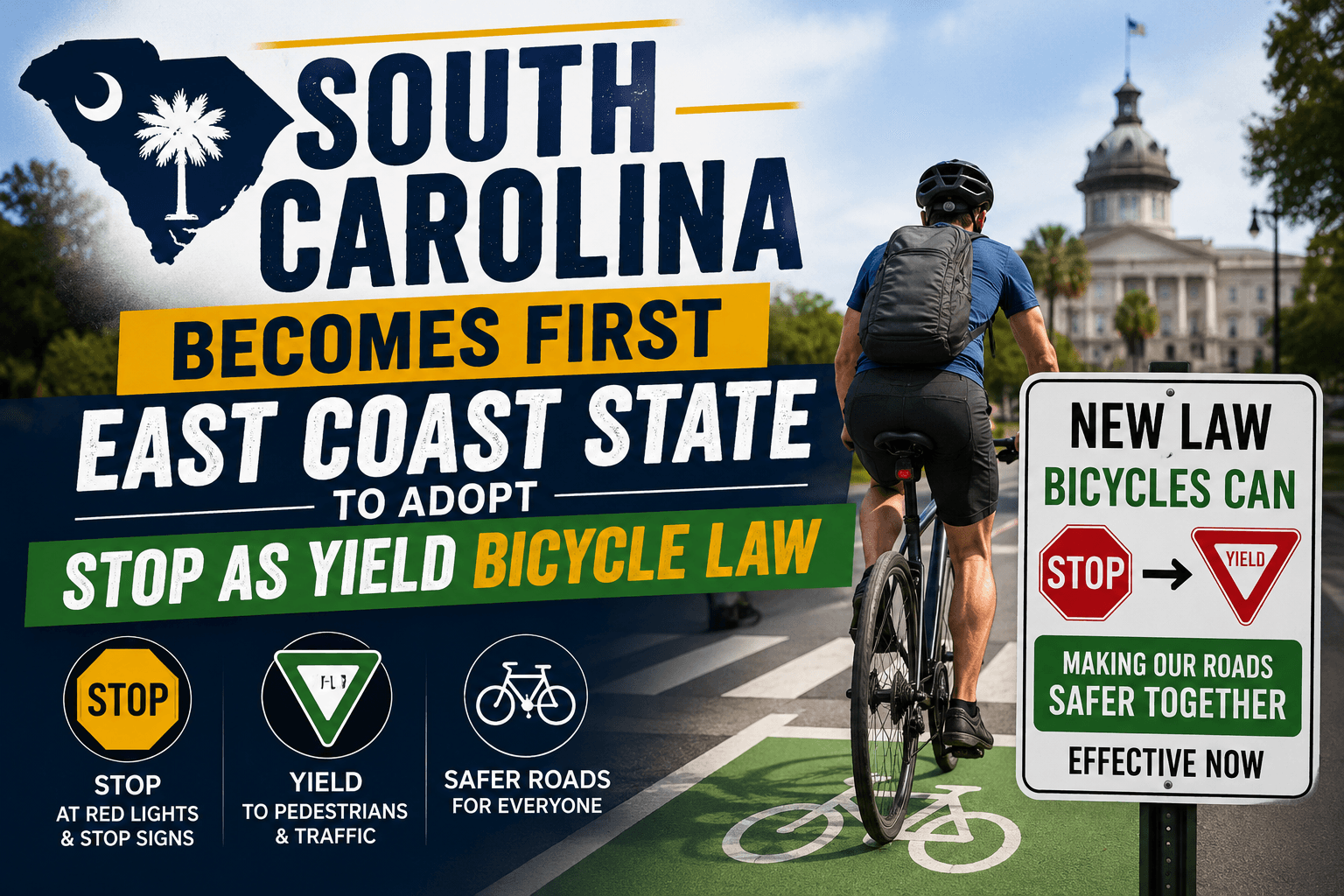
South Carolina Becomes First East Coast State to Adopt Stop As Yield Bicycle Law
New legislation changes how cyclists navigate intersections, bringing state policy in line with cycling realities
South Carolina — Cyclists across the Palmetto State have a new set of rules to ride by. South Carolina has become the first East Coast state to adopt a full Stop As Yield bicycle law, a change that treats stop signs less like a command to freeze and more like an invitation to slow, assess, and proceed when safe.
The new law makes South Carolina the 14th state to adopt such legislation and the first on the East Coast to allow stop-as-yield at stop signs and stop-then-proceed at red lights. For cyclists in Anderson and across the Upstate, it represents a significant shift in how they are expected to navigate intersections.
What the Law Actually Says
Under the new legislation, cyclists approaching a stop sign can treat it as a yield sign — slowing down, checking for cross-traffic and pedestrians, and proceeding through the intersection when it is safe to do so. At red lights, cyclists must come to a complete stop but can then proceed through the intersection if the way is clear.
This is a departure from the previous requirement that cyclists follow the same rules as motor vehicles, coming to a complete stop at every stop sign and waiting for green lights even when no traffic is present. The change recognizes a fundamental difference between bicycles and cars: cyclists have better visibility, can stop more quickly, and pose less danger to others if they proceed carefully through an empty intersection.
Why This Matters for Anderson Cyclists
For cyclists in Anderson County, the new law brings state policy in line with cycling realities. Anyone who has ridden a bike through residential neighborhoods or rural roads knows the frustration of stopping at a stop sign on a quiet street, putting a foot down, and then accelerating back up to speed for no practical safety reason.
The Stop As Yield approach, also known as the Idaho Stop after the state that first adopted it in 1982, has been shown to improve safety by keeping cyclists moving through intersections rather than creating situations where stopped cyclists are vulnerable to being hit from behind or losing momentum in traffic.
Anderson has seen growing interest in cycling, from recreational riders exploring the county's rural roads to commuters using bikes for transportation. This law makes those rides a little smoother and, proponents argue, a little safer.
The Legislative Path
The law passed with bipartisan support, reflecting growing recognition that cycling infrastructure and policy need to evolve. As more South Carolinians choose bikes for recreation and transportation, laws that acknowledge the unique characteristics of bicycles become increasingly important.
Critics have raised concerns about enforcement and whether the change might create confusion at intersections. Supporters counter that the law simply codifies what many cyclists were already doing safely, and that clear rules are better than rules that are widely ignored.
For now, cyclists in Anderson and across South Carolina can enjoy a little more freedom at intersections — with the responsibility to use that freedom wisely and safely.
Stay informed about local news and changes that affect life in Anderson County. Subscribe to Electric City Shoutouts for weekly updates delivered to your inbox. |

Anderson's Flock Camera Debate: Safety vs Privacy
Anderson Police say Flock cameras help solve crimes, but privacy advocates worry about surveillance overreach. Here's both sides of the story.

Denver Downs Farm Reveals 2026 Corn Maze Design Celebrating 250 Years of America
Denver Downs Farm unveils its 2026 corn maze design honoring 250 years of American history. Opening day is September 25th with fall festivities for the whole family.

Anderson Elks Lodge Hosts All-You-Can-Eat Breakfast Buffet on September 20
Anderson SC Elks Lodge #1206 invites the community to an all-you-can-eat breakfast buffet on September 20, 2026. Enjoy pancakes, eggs, bacon, biscuits & gravy, and more for just $12 per person.

MADWORLD Haunted Attraction Officially Open for 2026 Season in Piedmont
MADWORLD officially opened its doors on September 4, 2026, in Piedmont, SC. Explore massive upgrades and spooky new attractions at one of the Upstate's premier haunted destinations.
0 Comments
Join the conversation
Be the first to comment
Share your thoughts above.